Common Investing Myths for Women in Bangladesh, Debunked

By Raisa Khan
Junior Analyst
EDGE AMC Limited
Posted on: 03 Sep, 2026
Have you ever felt dismissed for simply wanting to talk about investing? Are you worried that what you have isn't "enough" to grow? Felt that your income is too modest to start investing? Or that the whole process is too complicated or intimidating to even begin?
These are common misconceptions. No financial institution has the right to treat you or your money differently because you are a woman. As a female investor, you have the same right to ask questions and access to information that a male investor does. You are not any less financially literate than a man who is investing for the first time. And you absolutely do not need a degree in Finance or Economics to begin investing and manage your own finances.
With consistency and an experienced, trustworthy team of asset managers, you can achieve your financial goals. In this article, we will explore some common myths about investing that make women hesitate to invest and why personal financial management is a necessary, entirely achievable skill for every woman.
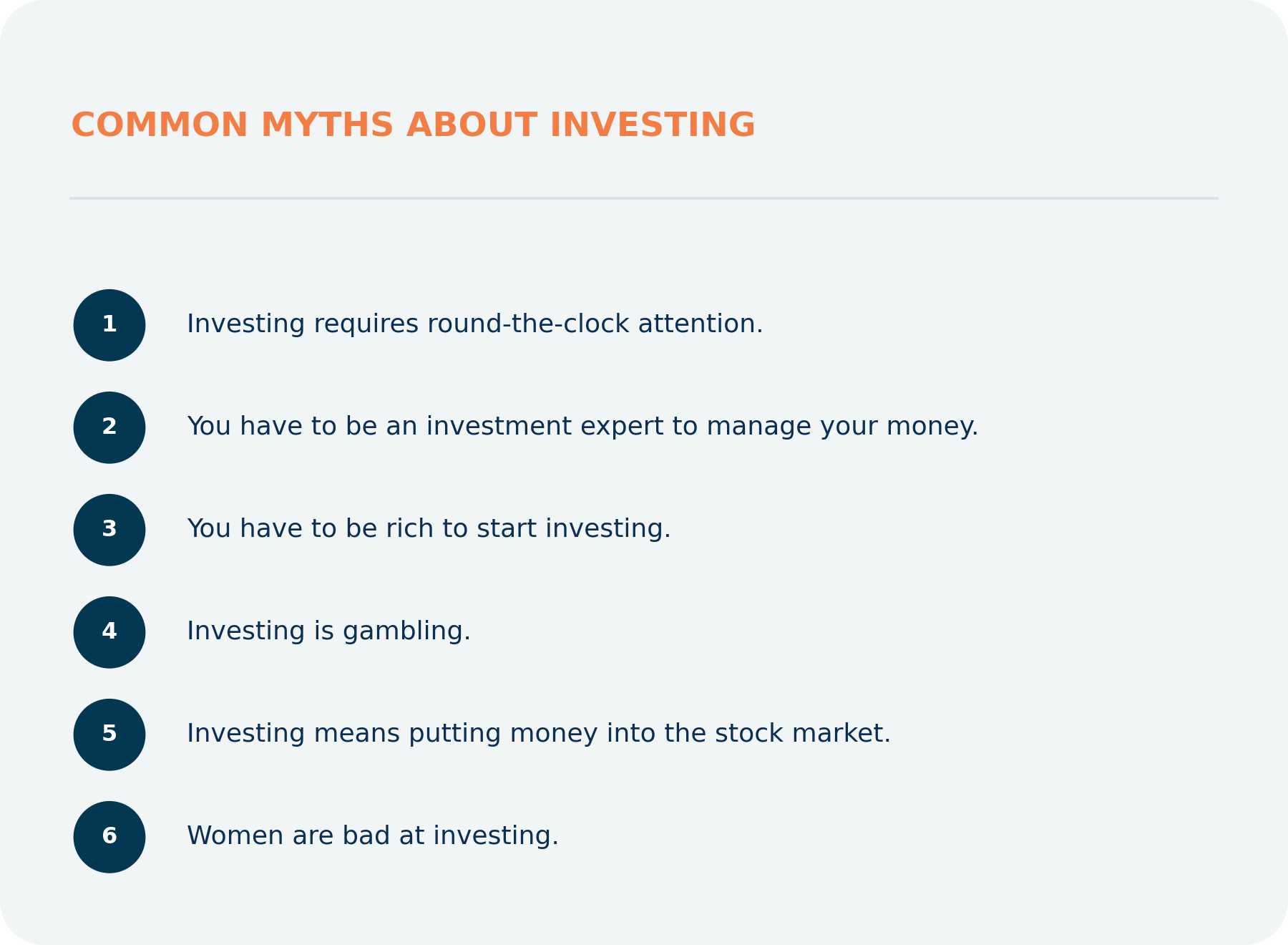
Why do women hesitate to invest? Let’s do some myth-busting.
Myth 1: Investing demands round-the-clock care.
Many view investing as something that has to be done round-the-clock. They believe it means constantly monitoring the stock market and tinkering with investments.
In reality, research tells a different story. It shows that investors who constantly trade and fuss over their investments make lower returns in the long-term compared to investors who buy and hold investments for a longer period of time by choosing good companies. Patience beats hyperactivity.
Myth 2: You have to be an investment expert to manage your money.
Many people assume that only experts can invest wisely. It can be daunting to pick stocks on your own. But what if you could delegate this task and get the services of an expert?
This is the entire thesis behind mutual funds. Opting for a mutual fund means that an experienced team of asset managers will read financial statements, track sector trends, monitor management changes and stay aware of macroeconomic conditions for you. These are people who make tricky investment decisions for a living. Asset management companies often offer multiple types of mutual funds to cater to the needs of different clients. Some funds are low risk, some are riskier but offer higher returns and some funds serve specific needs, such as Shariah-compliant funds. To compare the funds offered by EDGE AMC, take a look at this link. If you want to learn more about how asset management companies work, this article is a good place to start.
In practice, this means you only need to take two steps: decide to save, and decide how much. Once you have a financial goal and a timeline in mind, you already have what you need to start investing through a professionally managed vehicle like a mutual fund.
You can try our goal-based investing tool here, to figure out how much time it might take you to achieve your financial goal, accounting for your savings and income level.
Myth 3: You have to be rich to start investing.
Many believe that there is no point in investing unless you have a lot of money to invest. However, through the power of compounding and diligent investing, you can grow your money considerably. Imagine you start today with a BDT 1,000 per month SIP. A year later, your income rises and you increase your contribution. Keep this up — consistently investing a portion of your income, however modest — and your investment can grow into a considerable sum over time.
If you want to see a real-world illustration of compounding growth over time, we have an article explaining how a BDT 5,000 per month SIP in one of our mutual funds grew between 2018 and 2026.
Myth 4: Investing is gambling.
While it is true that the majority of stock investors in Bangladesh trade based on whatever the hottest rumor on the market is currently, you will not find any reputable financial institutions operating in such a way. This is because financial institutions, such as asset management companies, are regulated by the Bangladesh Securities and Exchange Commission.
To learn more about the safeguards built into mutual funds, take a look at this article.
The same discipline is available to individual ("retail") investors. If you pick good companies, there's no need to constantly hop from stock to stock chasing rumors. Smart investors make money by patiently waiting for the right moment to trade. And if you'd rather not manage that timing yourself, you can always invest in a professionally managed investment vehicle such as a mutual fund where a team of asset managers will handle the timing of trades for you.
Myth 5: Investing means putting money into the stock market.
The stock market is just one of many investment options. In Bangladesh, one popular low-risk instrument is the sanchayapatra. Additionally, there are also corporate bonds, treasury bills and bonds, etc. However, the process to invest in these other instruments as a retail investor is a little trickier compared to investing in the stock market but fixed-income funds solve that problem, investing exclusively in low-risk debt securities on your behalf.
If you are avoiding interest income, you can also opt for Shariah-compliant mutual funds such as the EDGE Al-Amin Shariah Consumer Fund.
Take a look at this article to learn about the different types of mutual funds.
Myth 6: Women are bad at investing.
In Bangladeshi society, it is assumed that it is the man’s duty to manage the household funds, or even to manage his spouse’s inheritance/income. Often, it is even joked that women cannot be trusted with money. However, does this seem like a practical arrangement? Why shouldn’t a woman manage her own money or maintain some emergency funds of her own?
Let’s look at some facts.
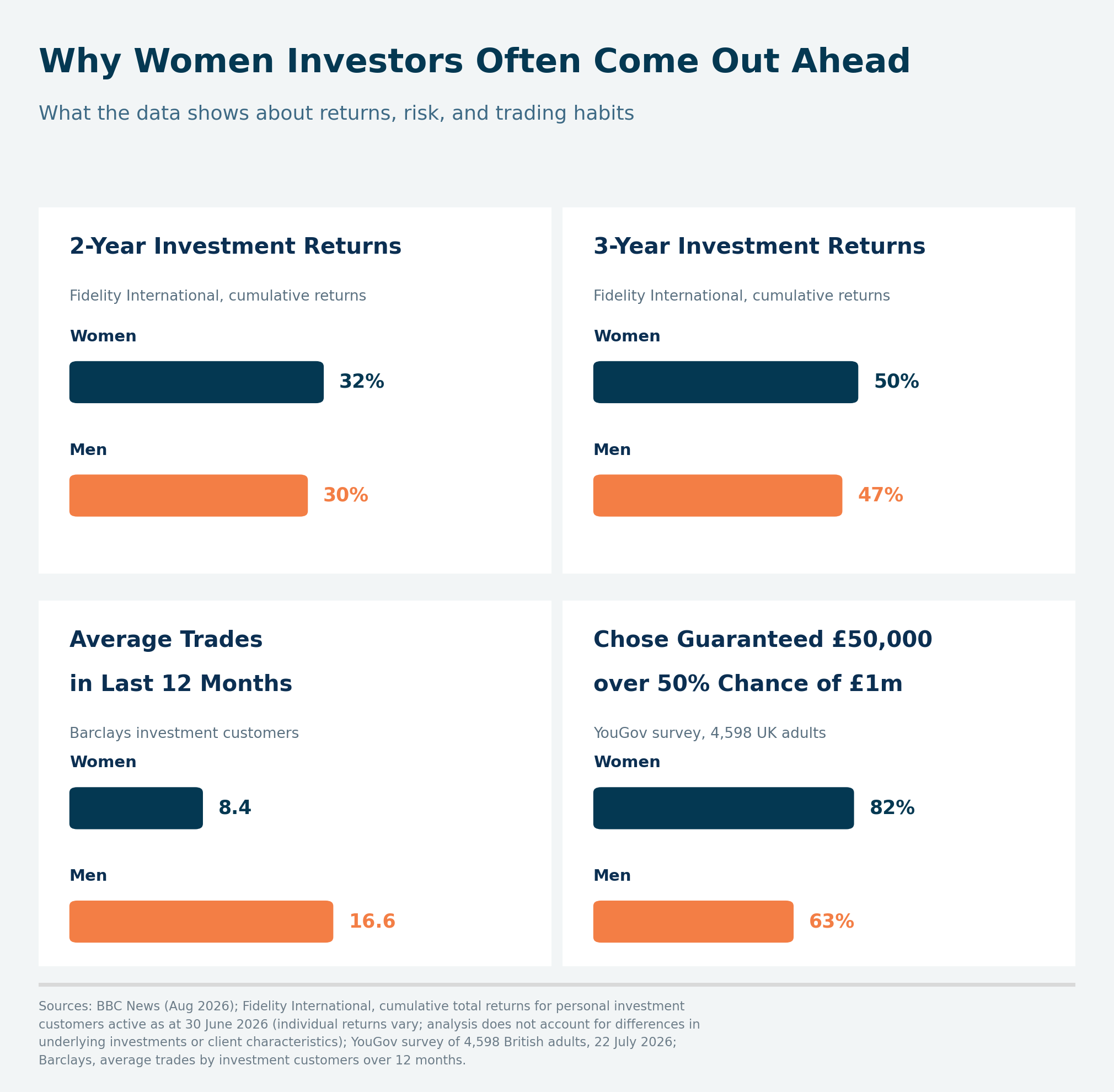
- Returns: According to this BBC article published in August 2026, women earn slightly higher long-term returns compared to men. Per Fidelity International, a global investment firm, women earned returns of 32% while men earned 30% over a 2-year period of investing. At the 3-year mark, women earned 50% vs. 47% for men*.
- Trading frequency: One reason for the difference in returns is that women trade less frequently, possibly because women are more patient and risk averse. A fascinating survey of 4,598 British adults conducted by YouGov asked participants to choose between a guaranteed GBP 50,000 and an over 50% chance of winning GBP 1 million. 82% of women chose the guaranteed GBP 50,000, while only 63% of men made the same choice. The survey found that women were deliberately more cautious.
- Transaction fees: Men tend to chase higher returns and end up trading more frequently and paying more in transaction fees. According to Barclays, a British multinational bank, the average number of trades by women over the last 12 months was 8.4 while for men it was 16.6.
- Portfolio design: Women also tend to invest more broadly but carefully across a wider variety of industries. Men tend to invest in technology companies for their higher expected returns.
- Creditworthiness: According to a report by the International Labour Office, the permanent secretariat and operational headquarters of the International Labour Organization (ILO), titled "Small change, Big changes: Women and Microfinance", microfinance originally targeted women because women historically did not have the same access to financial services that men did. However, women clients also registered higher repayment rates.
- Purpose-driven investing: Female investors in the UK were more likely to associate investing with their real-life goals, such as building emergency savings or childcare. In the context of Bangladesh, microfinance schemes have produced valuable insights into how women have historically managed money when they have access to capital. Studies have shown that women are more likely to invest their earnings in their families' education, healthcare, and nutrition. Women entrepreneurs reinvested a significant portion of the profits from their business in their children's education, thus breaking the cycle of intergenerational poverty.
*These are total returns across all customers who were active as at 30 June 2026. They do not account for differences in client characteristics and individual returns vary.
A realistic first step
Financial independence isn't only about need. It's about having your own documented financial footprint and decision-making authority over your own money.
Practically, this usually starts with opening a BO account in your own name, and a modest SIP. At EDGE AMC, you can start a Systematic Investment Plan (SIP) at BDT 1,000/month into a fund that matches your comfort level with risk. The amount matters far less at the outset than the habit and the ownership.
From there, the path is the same one anyone follows: increase the SIP as income allows, understand what you're invested in rather than delegating the decision entirely to a parent, a sibling or a spouse, and treat your portfolio as genuinely yours to track and grow.
Through intelligent investing, you can grow your money using instruments as safe or as risky as you want. If your goal is to build your wealth to a level that makes you feel financially stable, your best bet is to begin investing your money now.
Frequently Asked Questions
Q: Do I need my husband's or father's permission to open an investment account?
A: No. Any adult individual can open a BO account and invest in mutual funds in their own name and right.
Q: Is BDT 1,000/month really worth starting with?
A: Yes, the habit and the years of compounding it starts matter more than the initial amount, and most investors increase it over time. For lump sum investments, you can begin with BDT 5,000 at EDGE AMC.
Open your own BO account and start your first SIP with support from EDGE's investor onboarding team.
Links
- EDGE FAQ
- Investor portal
- BO Account 101
- What is a mutual fund
- Mutual Fund vs FDR vs Sanchayapatra vs DPS
Disclaimer: Investments are subjected to market risk. Past performance is not an indicator of future performance. This article is general information and does not constitute investment, legal, or tax advice for any specific fund. Trustee boards should obtain independent professional advice regarding their own circumstances and statutory obligations.
- Tags:
- Women and Investing, Investing Myths, EDGE AMC, Financial Independence, Mutual Funds Bangladesh, BO Account, SIP, Women Investors, Financial Literacy, Investor Education
Search
Categories
Recent Post
-
Common Investing Myths for Women in Bangladesh, Debunked
03 Sep, 2026 -
Before You Invest: 3 Risk Numbers Every Mutual Fund Investor Must Check
27 Aug, 2026 -
Mutual Fund vs FDR vs Sanchayapatra vs DPS: The Complete Guide for Bangladesh Investors
20 Aug, 2026 -
How EDGE Al-Amin Screens Stocks for Shariah Compliance: A Guide to Halal Investing in Bangladesh
19 Aug, 2026 -
Choosing the Right Mutual Fund in Bangladesh: A Complete Guide to Risk, Goals, and Fund Quality
17 Aug, 2026
Have Any Question?
If you have any questions feel free to reach out to us via phone or email.