Is Your Mutual Fund Investment Safe in Your Brokerage House? Here's How Your Units Are Protected

By Shajnin Mahbub
Investment Associate
EDGE AMC Limited
Posted on: 23 Sep, 2026
Investing in mutual funds involves several parties who assist clients with the investment process, one of which is a brokerage house. When you invest in a mutual fund, the asset manager transfers mutual fund units to the broker house with which you have a Beneficiary Owner (BO) account. Because the brokerage manages your BO account, it's natural to wonder, on top of the other uncertainties that come with investing, whether your units are actually safe there. Many investors ask the same question: “My mutual fund units sit in a BO account opened through my brokerage house. What happens to my investment if something goes wrong with the brokerage?"
The short answer is that your units are not stored with your brokerage house. Here is how the system works and why mutual fund investors have an extra layer of protection.
Who Actually Holds Your Units? CDBL, Not Your Brokerage
When you open a Beneficiary Owner (BO) account, you do it through a Depository Participant (DP), which is usually a brokerage house, bank, or merchant bank. It's easy to assume the DP is where your securities are kept. But it isn't.
- CDBL (Central Depository Bangladesh Limited) is the national depository. It holds and maintains the electronic records of your securities, including your mutual fund units.
- The DP is an intermediary. It operates your BO account on your behalf, providing the interface to open the account, submit instructions, and receive statements. It does not own or store your units.
- Think of it like a bank locker room. The DP is the front desk that helps you access your locker, but the vault and the record of what belongs to you are held by CDBL, in your name.
What This Means for You
Because CDBL keeps the records and the DP only operates the account:
- Your units are registered in your name. They are not pooled with, or treated as, the brokerage house's assets.
- A DP's business problems don't erase your holdings. Your ownership is recorded at CDBL, independent of the DP's own finances.
- Your units can't be moved without your authorization. Transfers require your instructions, and CDBL processes them.
You can see your holdings shared by the brokerage provider or directly on the CDBL website. BO account statements show what you own, so you can verify your position at any time from CDBL. CDBL also sends you an SMS whenever you do a trade in your BO. Generally, all these reporting should sync with each other- if you see any mismatch, flag it for a quick resolution.
The Extra Layer of Protection for Open-End Funds
Open-end mutual funds add an extra layer of safety versus direct investing against frauds or unauthorized selloffs. Stocks and closed-end funds are traded on the stock exchange, so every purchase and sale flows through a broker and depends on market matching and settlement. Open-end mutual fund units work differently:
- They are not listed or traded on the exchange.
- You buy units directly from the AMC (Asset Management Company) at the declared prices.
- You sell (redeem) units directly back to the AMC, again at the declared price based on the fund's Net Asset Value (NAV).
To see why this matters, let’s consider a worst-case scenario. Suppose a brokerage house wanted to misuse its access and somehow pushed through an unauthorized transfer from an investor's BO account without being caught at that stage. Even then, the money is not within reach. Because the sale proceeds are settled by the AMC directly, not by the brokerage, any request to withdraw funds has to come from the investor. A request from anyone else would stand out immediately and get flagged by the AMC before it could be paid out; and the AMC would payout only in the designated investor’s bank account - not to the Consolidated Customers’ Account (CCA) of the brokerage.
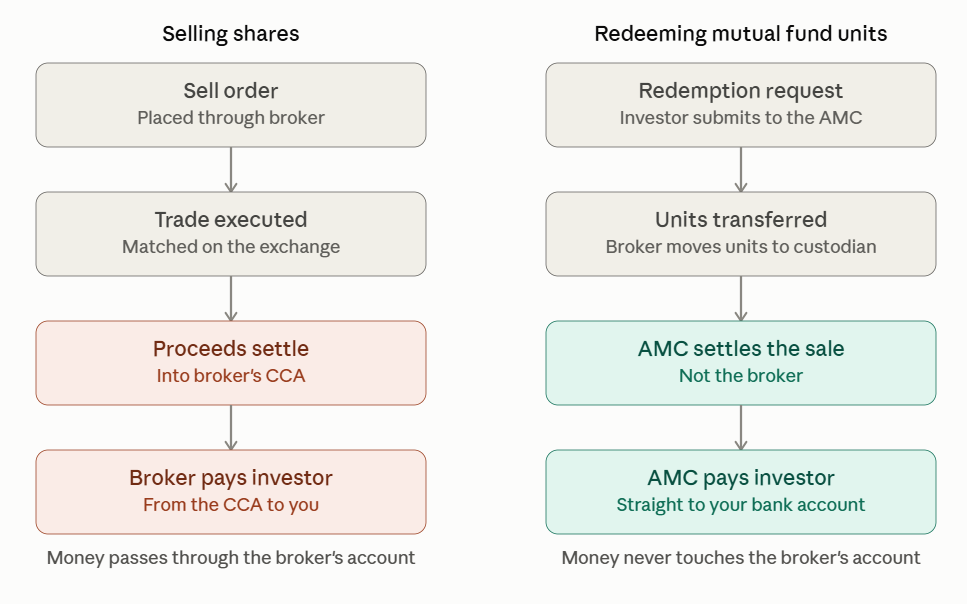
Figure: The difference between the settlement process of stocks and mutual funds
The Bottom Line
Since your mutual fund units are actually held at the CDBL and unit redemption proceeds are directly sent to your designated bank account by the AMC, the brokerage provider cannot initiate an unauthorized cash-out. Each mutual fund is separate legal entity from the AMC or brokerage. Hence, financial or business health of your AMC and brokerage do not have any bearing on the value of your mutual fund investments.
At EDGE AMC, we believe investors should understand not only how their money can grow but also how it is kept safe. If you have questions about holding or redeeming your units, our team is happy to help.
Disclaimer: Mutual fund investments are subject to market risks. Please read the fund's prospectus and offering documents carefully before investing. Past performance does not guarantee future results.
- Tags:
- Mutual Fund Safety, CDBL, BO Account, Investor Protection, Asset Management, Mutual Fund Bangladesh
Search
Categories
Recent Post
-
Is Your Mutual Fund Investment Safe in Your Brokerage House? Here's How Your Units Are Protected
23 Sep, 2026 -
প্রবাসী বাংলাদেশিদের জন্য গাইড: রেমিট্যান্সকে কীভাবে দীর্ঘমেয়াদী বিনিয়োগে রূপান্তর করবেন
10 Sep, 2026 -
৪.৮ লাখ থেকে ৭.০৯ লাখ: EDGEBDMF-এ ৮ বছরের SIP-এর একটি বাস্তব উদাহরণ
09 Sep, 2026 -
নতুন ৭৫ লাখ টাকার মিউচুয়াল ফান্ড সীমায় বাংলাদেশে আপনার ট্যাক্স রিবেট কীভাবে সর্বোচ্চ করবেন
09 Sep, 2026 -
EDGE Al-Amin কীভাবে শরিয়াহ সম্মত শেয়ার বাছাই করে: বাংলাদেশে হালাল বিনিয়োগের একটি গাইড
09 Sep, 2026
Have Any Question?
If you have any questions feel free to reach out to us via phone or email.